Broadband and polarization-independent complex amplitude modulation using a single layer dielectric metasurface

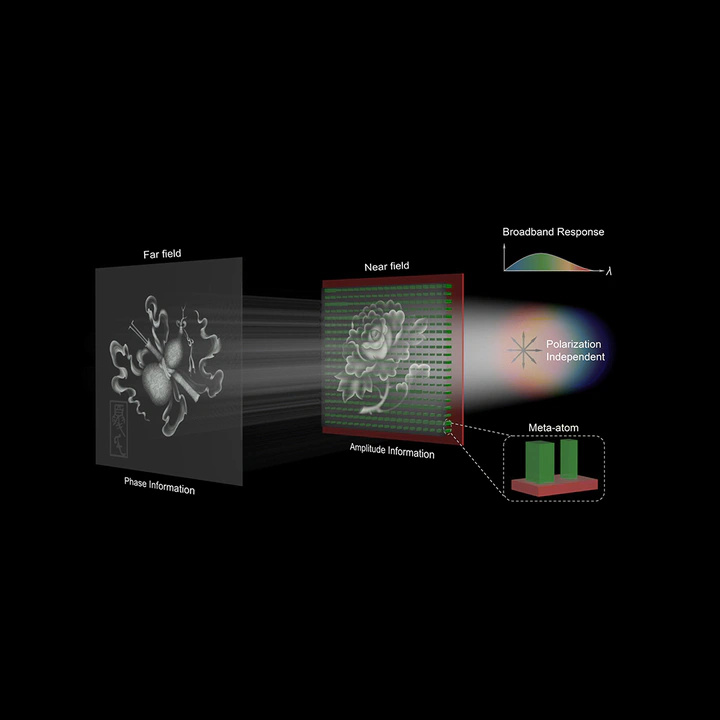 Concept of the complex amplitude modulation metasurface
Table of Contents
Abstract
In this work, we present a novel approach to achieving broadband and polarization-independent complex amplitude modulation using a single-layer dielectric metasurface. This breakthrough enables precise control over both the amplitude and phase of light across a wide spectral range (480–640 nm) without requiring specific polarization states.
Our work addresses a key challenge in optical engineering: traditional metasurface-based complex amplitude modulation techniques are often limited to narrow bandwidths or specific polarizations, restricting their practical applications. By leveraging dual meta-atom interference, we demonstrate robust, continuous, and high-resolution wavefront control that works under unpolarized and broadband illumination.
Key Innovations
- Polarization-Independent Operation
- Unlike conventional metasurfaces that rely on geometric phase or resonance effects (which require specific polarizations), our design uses isotropic nanorods arranged in superlattices to achieve polarization-insensitive modulation.
- This eliminates the need for additional polarizing optics, making the system more compact and versatile.
- Broadband Performance (480–640 nm)
- Traditional metasurfaces often suffer from wavelength-dependent performance, limiting their use in white-light applications.
- Our interference-based approach ensures stable amplitude and phase modulation across a broad spectrum, making it suitable for natural light illumination.
- Single-Layer, Easy-to-Fabricate Design
- Many existing methods for complex amplitude control require multi-layer structures or high-resolution grayscale fabrication, increasing complexity and cost.
- Our single-layer metasurface simplifies manufacturing while maintaining high performance.
Demonstrated Applications
We experimentally validated our design with two key applications:
1. Nanoprinting (Near-Field Amplitude Control)
- The metasurface encodes a flower-shaped amplitude pattern in the near field, visible under unpolarized light.
- This demonstrates high-resolution amplitude modulation for applications like optical encryption and micro-displays.
2. Fourier Holography (Far-Field Phase Control)
- The same metasurface generates a holographic “gourd” pattern in the far field, showcasing phase modulation for holographic displays.
- The hologram remains stable under different wavelengths and polarizations, proving robustness.
Why This Matters
Our work significantly reduces constraints on light sources, enabling metasurfaces to operate efficiently in real-world conditions (e.g., natural light, LED illumination). Potential applications include:
- Holographic displays (AR/VR, 3D projection)
- High-capacity optical communications
- Computational imaging and sensing
- Laser beam shaping and processing
Results

Figure 1. (a) A traditional amplitude control method based on polarization conversion, which has broadband response characteristics but exhibits polarization dependence. (b) Another traditional amplitude control method based on resonance, which has polarization-independent response but narrow bandwidth. (c) The amplitude control method based on multiple meta-atom interference in this work, which combines polarization independence and broadband response. (d) Schematic of the dual meta-atom unit cell. (e and f) Amplitude and phase responses with a wavelength of 532 nm using dual meta-atoms shown in (d). (g) A selection of 88 structures are displayed to demonstrate full-space amplitude and phase modulation in the complex plane, with normalized amplitudes ranging from 0 to 1, spaced by 0.1, and phases ranging from 0 to 2π, spaced by π/4. The structural parameters correspond to the white circles in (e) and (f).

Figure 2. (a) Simulation results of the metasurface nanoprinting and Fourier holography mixed display, the metasurface size is 2 × 2 mm. (b) Experimental results of near-field and far-field images under different polarization states. (c) Part of scanning electron microscopy image of the metasurface. (d) Schematic of the experimental setup for metasurface characterization: LED: light-emitting diode with a central wavelength of 532 nm, FI: filter, PH: pinhole, CL: collimating lens, MS: metasurface, Obj: microscope, TL: tube lens, FL: Fourier lens, f = 25 mm. The imaging part of nanoprinting and Fourier holography displays is highlighted with a blue box and a red box, respectively.

Figure 3. (a–i) Nanoprinting results of the metasurface at different wavelengths, with each wavelength converted to an RGB value for color display. (j–r) Fourier holography of the metasurface at different wavelengths; the central bright spot is unmodulated zeroth-order light.
Conclusion
By combining dual meta-atom interference with a single-layer dielectric metasurface, we’ve unlocked broadband, polarization-independent complex amplitude modulation—a major step toward practical, large-scale optical devices.

Related
- Single-layer metasurface for snapshot high-dynamic-range imaging
- Varifocal Metalens for Compact and Accurate Quantitative Phase Imaging
- Terahertz programmable metasurface based on free carrier plasma dispersion effect
- Multifunctional Metasurfaces Enabled by Multifold Geometric Phase Interference
- Fourier Phase Retrieval Using Physics-Enhanced Deep Learning