Single-layer metasurface for snapshot high-dynamic-range imaging

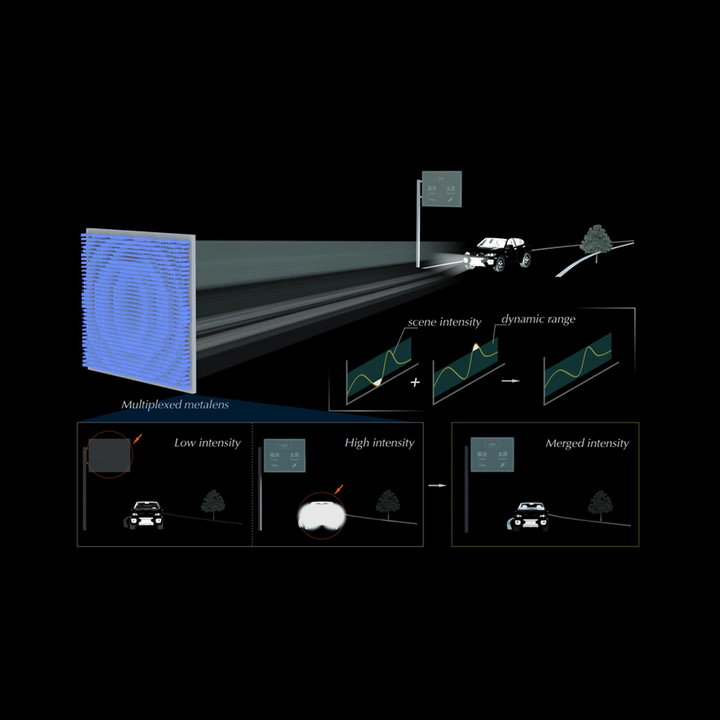 Concept of the complex amplitude modulation metalens based HDR Imaging
Table of Contents
Abstract
Research Problem:
In imaging systems, the limited dynamic range of conventional detectors makes it challenging to preserve details in both highlight and shadow regions within a single frame under environments with significant illumination variations. This issue is particularly prominent in applications such as smartphone photography, microscopic imaging, industrial manufacturing, and autonomous driving. The development of real-time high dynamic range (HDR) imaging devices is therefore of great significance.
Research Methodology:
This paper proposes an instantaneous HDR imaging scheme based on a single-layer metasurface (SiM-SHDR). The metasurface employs a polarization-independent full-space amplitude and phase modulation mechanism, enabling the capture of multiple images with different intensities in a single exposure. By fusing these images, the dynamic range of the resulting image is effectively expanded.

Figure 1. Design scheme of the HDR Metalens.
Experimental Design:
- Metasurface Design: A complex amplitude modulation method based on meta-atom interference was adopted to design a single-layer metasurface capable of simultaneous dual-channel imaging, with an intensity ratio of 10:1 between the two images.
- Experimental Validation: The metasurface sample was fabricated using electron-beam lithography, and its imaging performance was verified in an experimental setup. A 532 nm laser source was employed, and the captured dual-intensity images were processed using an image fusion algorithm.

Figure 2. Experimental results of dynamic range enhancement.
Results and Analysis:
- Dynamic Range Enhancement: Experimental results demonstrate that the proposed scheme achieves a dynamic range improvement of 17.5 dB, approaching the theoretical limit of 20 dB.
- Imaging Quality: The fused image successfully preserves details in both highlight and shadow regions, with peak signal-to-noise ratio (PSNR) and structural similarity index (SSIM) outperforming those of single-exposure images.
- System Integration: The single-layer metasurface replaces multiple components in traditional HDR systems, significantly reducing system volume and weight, making it suitable for lightweight, ultra-compact real-time HDR imaging applications.
Conclusion:
The SiM-SHDR scheme achieves efficient complex amplitude modulation via a single-layer metasurface, enabling the capture of multiple high-fidelity images in a single exposure and significantly enhancing dynamic range through fusion algorithms. This method exhibits notable advantages in system integration and imaging performance, providing a novel solution for real-time HDR imaging in fields such as smartphone photography, microscopic imaging, and autonomous driving.

Related
- Broadband and polarization-independent complex amplitude modulation using a single layer dielectric metasurface
- Varifocal Metalens for Compact and Accurate Quantitative Phase Imaging
- Terahertz programmable metasurface based on free carrier plasma dispersion effect
- Multifunctional Metasurfaces Enabled by Multifold Geometric Phase Interference
- Fourier Phase Retrieval Using Physics-Enhanced Deep Learning